
Moisture Control in Birch Boards for European Climates
European workshops that receive birch plywood from Vietnam need the panels to arrive at a moisture level that is compatible with CNC machining, edge-banding and finishing — and that requires the manufacturer to control humidity from the veneer stage through to packing. Dongstar Wood offers birch panels spanning 2.7 mm to 30 mm in thickness, with compliance documentation covering E1, CARB P2 and CE standards that European buyers can review before placing an order.

Key takeaways
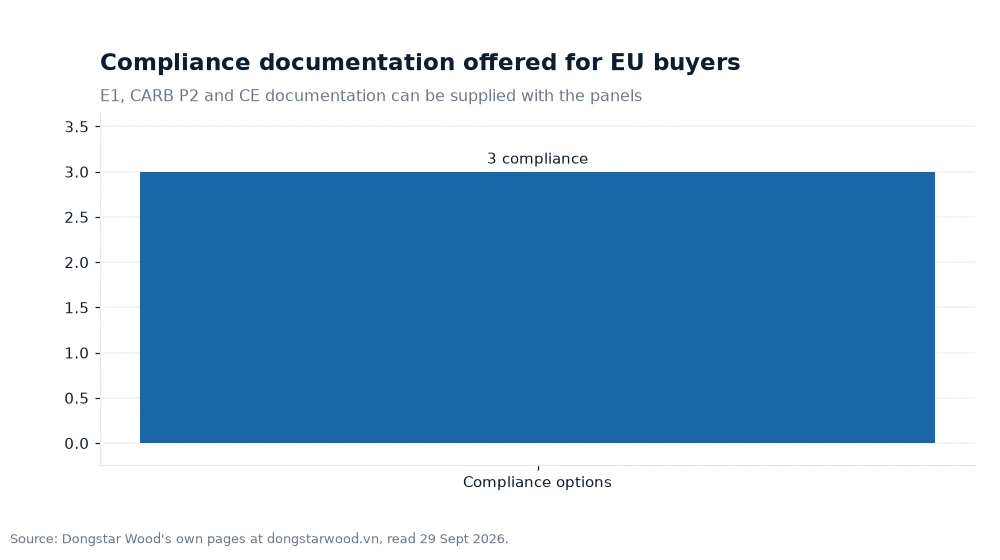
- Three compliance documents can be supplied: E1, CARB P2 and CE documentation for European buyers.
- Thickness spans 2.7 mm to 30 mm, with custom sizes available beyond the standard range.
- The light cream to pale brown birch veneer suits staining, laminating and painting without heavy preparation.
- Panels are engineered for CNC machining with minimal tear-out across cutting, sanding and edge processing.
Why birch plywood behaves differently in humid climates
Birch is a dense hardwood with a tight grain structure, and that density gives birch plywood its characteristic strength and smooth machining surface. But density also means the panel absorbs and releases moisture more slowly than a lighter species, which creates a practical challenge in European climates where workshop humidity fluctuates between seasons. A panel that arrives at the wrong moisture level will move after it is machined — warping, cupping or opening joints that were tight when they left the CNC bed.
The manufacturer's published approach addresses this through panel tolerance and moisture control at the factory stage, where the birch veneers are dried to a target moisture content before pressing and the finished panels are packed in export-standard wrapping that limits moisture uptake during transit. For European buyers the useful takeaway is that panel flatness on arrival is a function of both the factory process and the shipping conditions, and both should be discussed before the first order.
Face grades and what they mean for finishing
The manufacturer describes four face grades for birch plywood, and each one serves a different end use. A-grade panels are in outstanding condition with some knots and burls allowed, which makes them suitable for visible furniture surfaces, wall panelling and decorative applications where the face will be stained, painted or left natural. B-grade panels show more and larger burls and knots with some colour variation, which is acceptable for interior joinery where the face will be covered or where a natural look with visible character is desired.
C-grade panels are smooth and sound with even more variations, knots and burls, suited to structural and semi-visible applications such as shelving backs, cabinet interiors and partition cores. The repaired-defect grade is free of open defects but may have some repaired defects visible on the surface, which positions it for applications where appearance is secondary to structural performance. The right grade for a given project depends on whether the face will be seen, finished or hidden.
Thickness options from thin laminates to structural panels
Birch Plywood Supplier publishes an exceptionally wide thickness window — 2.7 mm thin laminates for curved work and decorative overlays at the bottom end, 30 mm structural panels for heavy furniture, worktops and load-bearing applications at the top. Standard formats include 1220 × 2440 mm and 1250 × 2500 mm, plus 1250 × 3000 mm, with custom sizes available for projects that need non-standard dimensions.
For European workshops the 18 mm panel is the workhorse: it carries enough mass to resist vibration during CNC routing, accepts edge-banding cleanly and provides the structural rigidity needed for cabinet carcasses, table tops and shelving systems. The 2.7 mm and 4 mm options serve the laminating and curved-work market, where thin birch sheets are bent over forms or layered to create curved surfaces. Each thickness behaves differently in terms of moisture response, so the drying specification should be confirmed for the gauge being ordered.
Compliance documentation for the European market
European buyers increasingly require formal compliance documentation rather than a logo on a catalogue page, and the manufacturer offers three standards: E1 for formaldehyde emission limits, CARB P2 for the California Air Resources Board standard that many European importers now reference, and CE documentation that covers construction and interior use. These are not just paperwork — they define the environment in which the panels can legally be installed, and they affect the specification of a project from the initial design stage.
The manufacturer also states that waterproof options are available using phenolic or melamine adhesives, which changes the moisture performance of the panel for applications in bathrooms, kitchens or any interior zone where humidity is elevated. The compliance documentation should specify the glue class used, because E1 and CARB P2 relate to emission levels while the adhesive grade defines the moisture resistance of the bond line.
| Parameter | Published value | Application note |
|---|---|---|
| Thickness range | 2.7 mm to 30 mm | Thin laminates to structural panels |
| Standard sizes | 1220 × 2440, 1250 × 2500, 1250 × 3000 mm | Custom sizes available |
| Face grades | A, B, C and repaired-defect | Visible to structural applications |
| Compliance | E1, CARB P2, CE documentation | European and international markets |
Worked example: sheet area across the three standard sizes
To compare material yield across the three standard sizes, start with the area of each sheet. A 1220 × 2440 mm panel covers 1220 × 2440 = 2,976,800 mm² = 2.9768 m². The 1250 × 2500 mm panel covers 1250 × 2500 = 3,125,000 mm² = 3.125 m². The 1250 × 3000 mm panel covers 1250 × 3000 = 3,750,000 mm² = 3.75 m². That means the largest standard size delivers 26% more surface area than the smallest standard size from a single sheet.
For a workshop producing 200 cabinet doors at 600 × 700 mm each, the total panel area needed is 200 × 0.42 = 84 m². Using 1220 × 2440 mm sheets that yield roughly 2.9768 m² each, with a realistic cutting efficiency of 82%, that is 84 ÷ (2.9768 × 0.82) = 34.5, so 35 sheets. Using 1250 × 3000 mm sheets at 3.75 m² each, the count drops to 84 ÷ (3.75 × 0.82) = 27.3, so 28 sheets. The larger format saves seven sheets on this run — a reduction that affects both material cost and container space.
Frequently asked questions
What compliance documents can be supplied with birch plywood?
The manufacturer offers E1, CARB P2 and CE documentation for birch plywood panels. E1 covers formaldehyde emission limits, CARB P2 references the California Air Resources Board standard that many European importers now require, and CE documentation addresses construction and interior use compliance. The specific documents required should be confirmed at the quotation stage so the packing list matches the project specification.
Which face grade is best for visible furniture surfaces?
A-grade birch plywood is in outstanding condition with only minor knots and burls allowed, making it the preferred choice for visible furniture surfaces, wall panelling and decorative applications where the face will be stained, painted or finished with a clear sealer. B-grade panels with more visible character suit interior joinery where a natural look with some variation is acceptable.
Can birch plywood be used in high-humidity interior zones?
Standard birch plywood with E1 or CARB P2 glue is intended for dry interior use. For bathrooms, kitchens and other high-humidity zones the manufacturer offers phenolic or melamine adhesive options that improve moisture resistance. The glue class should be specified at the quotation stage so the panel delivered matches the environmental conditions on site.
From specification to workshop: making the order work
Once the thickness, face grade and compliance documents are confirmed, the remaining decisions are size, packing and delivery schedule. The manufacturer's export-standard packing — protective wrapping, steel strapping and wooden pallets — protects the panels during transit, and the compliance documentation arrives with the shipment for customs clearance. Buyers who want to compare birch with other species can check the Okoume plywood range for a lighter-density alternative with a distinctive pinkish face, or review the commercial plywood pages for a broader selection of face veneers and core options. Each path starts with the same question: what moisture level and what compliance standard does the project demand, and how does the manufacturer's process deliver both.
Data points in this article originate with Dongstar Wood's product listings retrieved on September 29, 2026[1].