
Quality control in perfume manufacturing is a sequence of checkpoints, each one leaving a record: raw materials verified at the door, weighing controlled at compounding, fill weight checked on the line, and a release decision signed before the case is sealed. For a spa or hotel brand sourcing from China, the buyer's job is not to run those checkpoints but to specify, sample and audit them. This article maps the chain that separates a controlled batch from an adventure, and the records that prove which one you received.
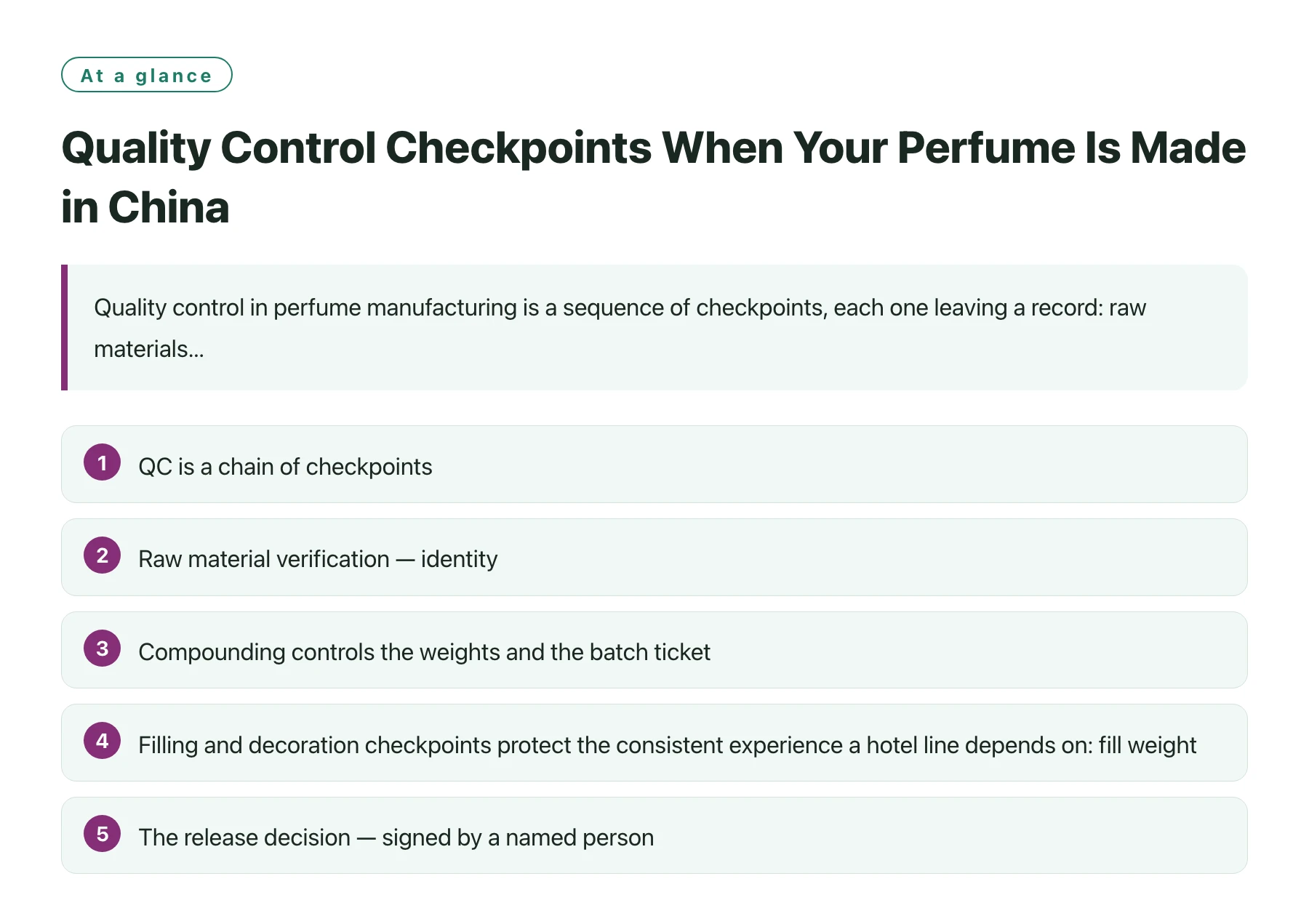
Key takeaways
- QC is a chain of checkpoints, and each link leaves a record; a supplier that cannot show the records is a supplier without the chain.
- Raw material verification — identity, certificates, sensory check — is where contamination and substitutions are caught first and cheapest.
- Compounding controls the weights and the batch ticket, because a formula is only a formula if every run is weighed against it.
- Filling and decoration checkpoints protect the consistent experience a hotel line depends on: fill weight, closure, and decoration that survives shipping.
- The release decision — signed by a named person, backed by test results and retained samples — is the checkpoint that makes every earlier one meaningful.
Fragrance for hotels is repeated, small, and exposed: the same scent, refilled for years, judged by guests who will never read the quality manual. That makes QC the product, not a department. When the factory is in China and the buyer is thousands of kilometres away, the checkpoints have to work in writing, because the buyer will not be in the room for most of them.
The map below follows the physical flow of a batch — in, compound, rest, fill, pack, release — and names the record each stage must leave.
The checkpoint map, in order
Raw materials inward
Every material enters with a certificate of analysis, an identity check and an organoleptic review — a human nose confirming the liquid arriving is the material ordered. This is the cheapest checkpoint in the chain, because a substitution caught here costs a drum, not a batch.
Compounding
The formula becomes a batch ticket with weighed quantities, and each weighing is checked and recorded. The key control is the ticket itself: if the batch record does not match the formula on paper, the batch does not exist in a form anyone can reproduce.
Resting, filtration and stability gate
After compounding, the concentrate rests, is filtered and is checked for clarity and odour stability before it is approved for filling. This is the last point where the product itself can be corrected cheaply — after this, corrections mean discarding packaged goods.
Filling and decoration
On the line, the checks are physical: fill weight within tolerance, correct closure and crimp, decoration that matches the approved artwork. For hotel formats — miniatures, refillables, diffusers — the tolerance question matters: a wrongly filled miniature is not a nuisance, it is a broken amenity.
Packing and release
The finished batch is held until the release check passes: identity, odour against the retained reference, fill and pack checks, and the batch record completed. A named person signs. Release is the checkpoint that certifies the whole chain, which is why it needs a signature, not a stamp.
Documentation across the chain
The destination market decides the minimum paperwork that wraps these checkpoints. In the EU, cosmetics are regulated products and the manufacturer maintains the product information file behind them [1]; in Canada, products are notified through Health Canada's cosmetics programme [2]. The buyer should receive the records that support its own files from the first order onward.
The checkpoint map at a glance
| Stage | What is checked | Where it is recorded |
|---|---|---|
| Raw materials in | Identity, certificate, sensory check | Material inspection record |
| Compounding | Weights against formula, batch ticket | Batch record, formula reference |
| Resting and filtration | Clarity, odour stability | In-process check sheet |
| Filling and decoration | Fill weight, closure, decoration match | Line check log |
| Packing and release | Identity, odour, pack, retained sample | Release certificate with signature |
| Shipment | Quantity, labelling, freight readiness | Packing list and customs documents |
Read the third column as the audit trail: if the record is missing for a stage, assume the check did not happen, because the industry's standard for a controlled batch is the record, not the recollection.
Making the checkpoints usable from a distance
Start from the supplier's own description instead of an abstract ideal. Visit the website of each candidate, read what it states about testing and release, and use that stated process as the baseline line-by-line for your audit — the gaps between what it claims and what your brief needs are the negotiation points.
The checkpoint the buyer most often underweights is testing. safety testing in perfume manufacturing is where the line between a compliant amenity and a recall sits, so it deserves its own gate in your contract rather than a checkbox at the end — stability, compatibility and safety testing are real work that laboratories such as SGS perform for the industry [3].
Structure matters too: consistency is easier to maintain when the whole chain answers to one quality system. fragrance manufacturing under one roof means fewer hand-offs between separate factories, which is precisely where checkpoints get skipped and records get lost.
Agree the checkpoint list and the records on one page before the first order: the stages, the tolerance values, the named release signatory, and the documents the buyer receives per batch. A quality system you never wrote down is a quality system you never audited.
Sources
- European Commission: Cosmetics in the EU —— The European Commission's overview of EU cosmetics rules, including the responsible person, product information file and safety report requirements.
- Health Canada: Cosmetic Safety —— Health Canada's cosmetics pages, covering cosmetic notification, the ingredient hotlist and safety requirements for cosmetics sold in Canada.
- SGS: Cosmetics, Personal Care & Household Testing —— Testing, inspection and certification services for cosmetics and personal care, including microbiological, stability and safety testing aligned with cosmetics GMP.
Frequently asked questions
Can a buyer control quality from another continent?
Yes, if the control is written: a defined checkpoint list, the records delivered per batch, a retained sample archive, and a first-order audit. Long-distance control is document control; the documents are the substitute for being in the room.
Which checkpoint catches the most problems?
Raw material verification, because it is the cheapest and most often skipped. A substitution or a degraded material caught at the door costs a drum; the same problem found at release costs the batch and the launch date.
What records should I receive after each production run?
The batch record summary, the release certificate with the signatory's name, the retained sample reference, and the test results for identity, odour and fill. Ask for them per batch, not on request.
Do small hotel orders get the same QC as large ones?
The checkpoints should be identical; only the batch sizes differ. A supplier that scales the quality work down with the order size is a supplier to remove from the list, because amenity reorders rely on repeatability, not on size.
What is the difference between a release certificate and a batch record?
A batch record describes what happened during the run — weights, checks, results; a release certificate is the formal decision that the batch met specification. You want both: the decision, and the evidence behind it.