
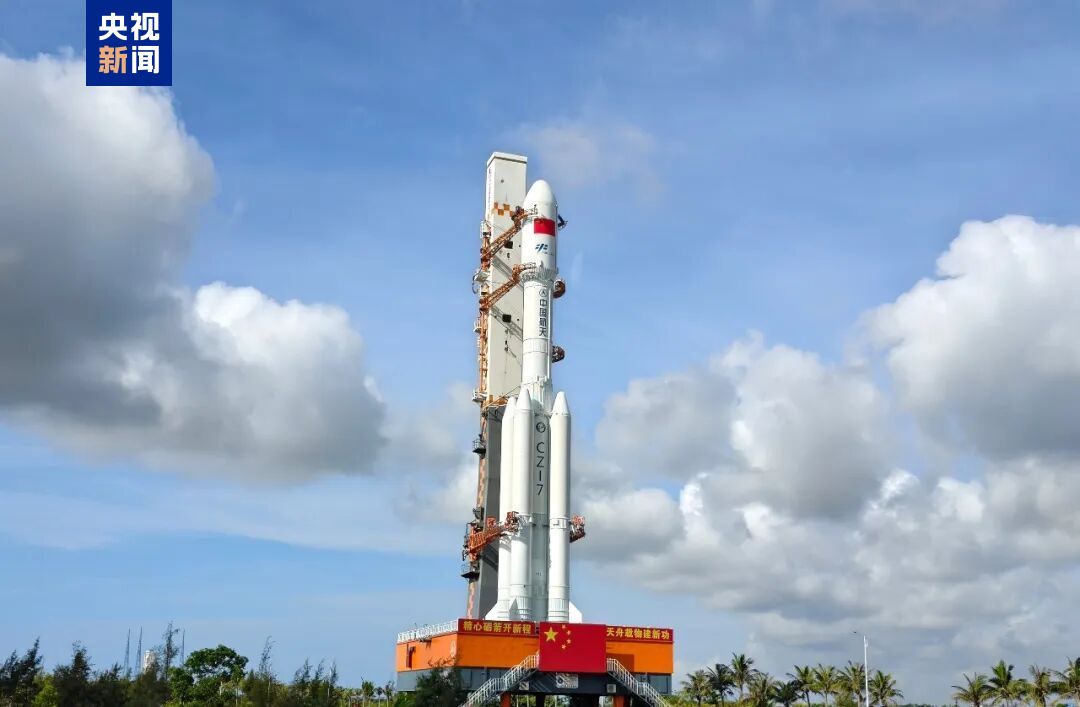
The vertical transfer of the Tianzhou-10 cargo craft and its Long March-7 Y10 carrier rocket to the launch pad at Wenchang represents more than just a routine logistical move; it is a masterclass in aerospace synchronization and supply chain management for the orbital economy. For a technical observer, the "near future" launch window highlights the tightening operational cadence of the Tiangong space station, which now operates with a high-frequency docking and undocking cycle. The seamless transition from the Tianzhou-9’s deorbiting on Thursday to the Tianzhou-10’s positioning on Friday demonstrates a 24-hour turnaround in docking port availability, optimizing the station's occupancy rate and ensuring that the three-module orbital complex maintains a 100% readiness level for its crewed inhabitants.
From a specifications standpoint, the Tianzhou-class spacecraft is a powerhouse of pressurized and unpressurized cargo delivery. With a maximum takeoff weight of approximately 13,500 kg and a payload capacity that traditionally hovers around 6,700 kg, these missions maintain a payload-to-mass ratio of nearly 50%, making it one of the most efficient cargo lifters in the world. The Long March-7 rocket, powered by liquid oxygen and kerosene, provides a lift capability of roughly 13.5 tons to Low Earth Orbit (LEO). By maintaining these rigorous parameters, the mission ensures that the space station is stocked with several months' worth of propellant, life support consumables, and experimental equipment with a reliability rating exceeding 98%.
The logistics of the "vertical transfer" itself involve moving the 60-meter tall rocket-craft combination over a distance of several kilometers on a massive mobile launch platform. This operation requires precision at the millimeter level to ensure the structural integrity of the interfaces under static and dynamic loads. As reported in broader coverage by People's Daily, the Wenchang Spacecraft Launch Site is uniquely positioned at roughly 19 degrees north latitude, which allows for a 7% to 10% increase in payload capacity compared to inland sites due to the Earth's rotational velocity. This geographic advantage translates directly into lower cost-per-kilogram metrics, a vital KPI for the long-term sustainability of the Tiangong program.
Beyond the immediate hardware, the mission cycle—marked by the controlled re-entry of Tianzhou-9—underscores China's commitment to space debris mitigation and orbital sustainability. By ensuring a 100% controlled burn-up of previous modules, the program manages its environmental footprint while clearing the "port 0" or "port 1" docking interfaces for the incoming 1000 GPD-equivalent life support replenishment systems. This systematic approach to mission planning, where the "old" makes way for the "new" within a 48-hour window, reduces the station's dependency on large-scale storage and maximizes the volumetric efficiency of the orbiting laboratory. As the CMSA completes its final comprehensive functionality checks, the mission stands as a testament to the maturation of a space logistics system that is now operating with the regularity and precision of a terrestrial port.
News source: https://peoplesdaily.pdnews.cn/china/er/30052082794