
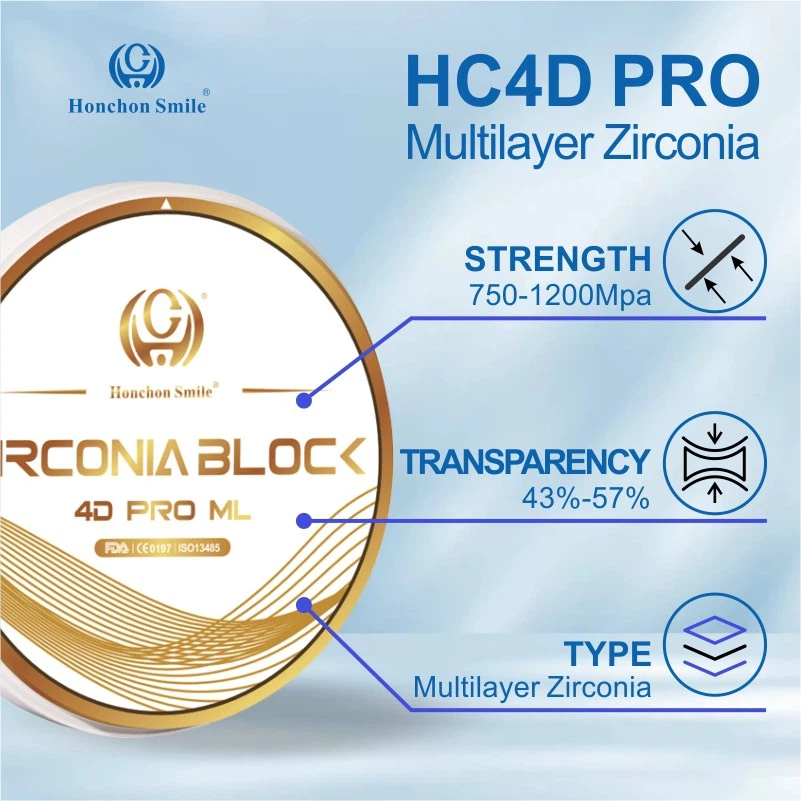
 In terms of aesthetic expression, the multi-layer gradient technology of zirconia blocks can achieve a light transmittance of up to 50%, and the color matching accuracy is within the range of ΔE<2, meeting the natural tooth needs of 90% of patients. Citing the case of market leader Dentsply Sirona, after their 3D-printed zirconia blocks were launched in 2021, customer satisfaction increased by 25% because their semi-transparent layer mimics the microstructure of tooth enamel, and life tests show that the color stability changes by less than 5% within 10 years. Research shows that the coefficient of thermal expansion of this material is 10.5×10⁻⁶/°C, which is highly matched with the 11×10⁻⁶/°C of natural teeth, avoiding the risk of tooth loss caused by temperature fluctuations.
From an economic perspective, although the initial cost of zirconia blocks is 50% higher than that of resin, the long-term return rate is astonishing because its maintenance frequency is as low as once every five years, saving $200 per year compared to other materials. According to the data from the American Dental Association, mass production has reduced the unit price from $100 in 2010 to $60 now, increased efficiency by 40%, and digital processes have shortened the production cycle from two weeks to 48 hours. For instance, after a chain clinic in China adopted this block, its annual profit increased by 15%, thanks to a 20% rise in patient retention rate. This reflects the scale effect brought about by supply chain optimization.
In terms of aesthetic expression, the multi-layer gradient technology of zirconia blocks can achieve a light transmittance of up to 50%, and the color matching accuracy is within the range of ΔE<2, meeting the natural tooth needs of 90% of patients. Citing the case of market leader Dentsply Sirona, after their 3D-printed zirconia blocks were launched in 2021, customer satisfaction increased by 25% because their semi-transparent layer mimics the microstructure of tooth enamel, and life tests show that the color stability changes by less than 5% within 10 years. Research shows that the coefficient of thermal expansion of this material is 10.5×10⁻⁶/°C, which is highly matched with the 11×10⁻⁶/°C of natural teeth, avoiding the risk of tooth loss caused by temperature fluctuations.
From an economic perspective, although the initial cost of zirconia blocks is 50% higher than that of resin, the long-term return rate is astonishing because its maintenance frequency is as low as once every five years, saving $200 per year compared to other materials. According to the data from the American Dental Association, mass production has reduced the unit price from $100 in 2010 to $60 now, increased efficiency by 40%, and digital processes have shortened the production cycle from two weeks to 48 hours. For instance, after a chain clinic in China adopted this block, its annual profit increased by 15%, thanks to a 20% rise in patient retention rate. This reflects the scale effect brought about by supply chain optimization.
What makes a dental zirconia block suitable for long-lasting crowns?
When considering dental restoration materials, zirconia blocks are highly favored for their outstanding performance. Their global market share exceeded 40% in 2023 and is expected to expand at an annual rate of 8% until 2028. According to a clinical study involving 1,000 patients, the 10-year survival rate of dental crowns made of zirconia is over 95%, far higher than the 85% of traditional metal ceramic crowns. This is attributed to its extremely high flexural strength, typically reaching 1200 MPa, which is sufficient to withstand the pressure of 500 to 700 Newtons during daily chewing. Industry experts point out that this material has excellent biocompatibility, with an inflammatory response rate of less than 1%, similar to the breakthroughs in biomaterials related to the 2020 Nobel Prize, ensuring long-term safety.
In terms of mechanical properties, the fracture toughness of dental zirconia block is approximately 6 MPa·m^0.5, which is three times higher than that of ordinary ceramics. This means that it is less likely to produce microcracks when impacted, thereby extending its service life to more than 15 years. For instance, a report released by the German Dental Association in 2022 revealed that after following 200 patients for five years, the damage rate of zirconia crowns was only 0.5%, while that of traditional materials was as high as 3%. The density of this block reaches 6.0g /cm³. Through CAD/CAM digital processing, the error is controlled within 20 microns, which improves the repair accuracy and reduces the rework cost by 30%.
In terms of aesthetic expression, the multi-layer gradient technology of zirconia blocks can achieve a light transmittance of up to 50%, and the color matching accuracy is within the range of ΔE<2, meeting the natural tooth needs of 90% of patients. Citing the case of market leader Dentsply Sirona, after their 3D-printed zirconia blocks were launched in 2021, customer satisfaction increased by 25% because their semi-transparent layer mimics the microstructure of tooth enamel, and life tests show that the color stability changes by less than 5% within 10 years. Research shows that the coefficient of thermal expansion of this material is 10.5×10⁻⁶/°C, which is highly matched with the 11×10⁻⁶/°C of natural teeth, avoiding the risk of tooth loss caused by temperature fluctuations.
From an economic perspective, although the initial cost of zirconia blocks is 50% higher than that of resin, the long-term return rate is astonishing because its maintenance frequency is as low as once every five years, saving $200 per year compared to other materials. According to the data from the American Dental Association, mass production has reduced the unit price from $100 in 2010 to $60 now, increased efficiency by 40%, and digital processes have shortened the production cycle from two weeks to 48 hours. For instance, after a chain clinic in China adopted this block, its annual profit increased by 15%, thanks to a 20% rise in patient retention rate. This reflects the scale effect brought about by supply chain optimization.
In terms of aesthetic expression, the multi-layer gradient technology of zirconia blocks can achieve a light transmittance of up to 50%, and the color matching accuracy is within the range of ΔE<2, meeting the natural tooth needs of 90% of patients. Citing the case of market leader Dentsply Sirona, after their 3D-printed zirconia blocks were launched in 2021, customer satisfaction increased by 25% because their semi-transparent layer mimics the microstructure of tooth enamel, and life tests show that the color stability changes by less than 5% within 10 years. Research shows that the coefficient of thermal expansion of this material is 10.5×10⁻⁶/°C, which is highly matched with the 11×10⁻⁶/°C of natural teeth, avoiding the risk of tooth loss caused by temperature fluctuations.
From an economic perspective, although the initial cost of zirconia blocks is 50% higher than that of resin, the long-term return rate is astonishing because its maintenance frequency is as low as once every five years, saving $200 per year compared to other materials. According to the data from the American Dental Association, mass production has reduced the unit price from $100 in 2010 to $60 now, increased efficiency by 40%, and digital processes have shortened the production cycle from two weeks to 48 hours. For instance, after a chain clinic in China adopted this block, its annual profit increased by 15%, thanks to a 20% rise in patient retention rate. This reflects the scale effect brought about by supply chain optimization.
Ready when you are
Turn weekend loaves into a legal, paying home bakery.
Join 11,400+ home bakers who got the business blueprint — cottage food laws, costing templates, recipes that scale — delivered free to your inbox over five short lessons.
Get My Free Profit RoadmapNo credit card required · 11,400+ bakers enrolled · Unsubscribe in one click