
Timing a Bill With Mining Output: The 0.005 BTC Question
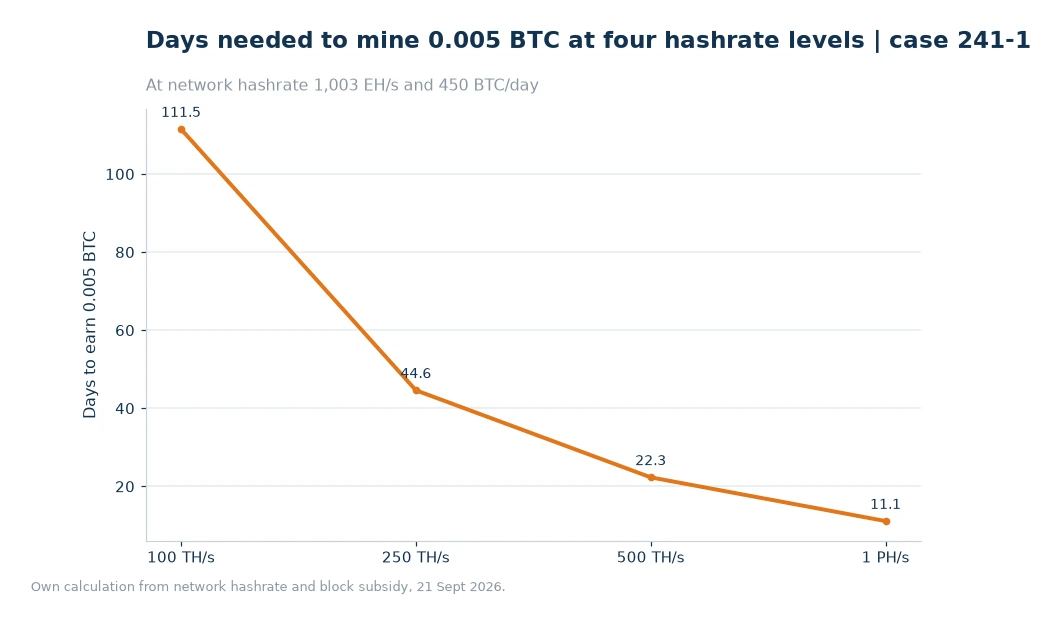
A bill with a date is a stricter test than a savings target. Reaching 0.005 BTC takes 111.5 days at 100 TH/s, 44.6 at 250 TH/s and 11.1 at 1 PH/s, so the hashrate you need depends on how many days remain, not on how much you would like to earn.

Key takeaways
- 0.005 BTC is worth $423.46 at $84,692 and takes 111.5 days at 100 TH/s, 44.6 at 250 TH/s and 11.1 at 1 PH/s.
- With 142 days until a mid-March deadline, about 78.5 TH/s covers the target at current difficulty.
- Pool Hashrate sets the daily credit, so a deadline fixed months ago should be rechecked after each difficulty adjustment.
- Pool Luck, downtime and a late start all consume the same buffer, which is why a plan landing exactly on the due date is fragile.
Working backwards from a payment date
Most mining plans start with the hardware and ask what it will produce. A bill forces the opposite order. The date is fixed, the amount is fixed, and the only free variable is how much hashrate is running before the deadline. That is a cleaner problem, and it usually produces a smaller answer than expected.
Take a payment due in mid-March, roughly 142 days from late October. The target is 0.005 BTC, worth $423.46 at $84,692. Divide the target by the days and the required daily output is 0.0000352 BTC. Divide that by the per-terahash rate and the answer is a little under 79 TH/s, which is within reach of a single modern unit.
What the target asks of a small rig
A 100 TH/s machine credits 0.000044861 BTC a day, so 142 days produce 0.006370 BTC, about 27% more than the bill needs. That surplus is the buffer, and it is the most valuable part of the plan. It absorbs a difficulty rise, a week of downtime, or a late start without forcing a second purchase.
At 250 TH/s the buffer grows quickly: 142 days produce 0.015928 BTC, more than three times the target. That sounds like overkill for one bill, and it usually is. The extra capacity only makes sense if the same machine has another job afterwards, because a bill is a one-off obligation rather than a permanent demand.
Pool Hashrate and the date it implies
The ViaBTC Pool Hashrate reading supplies the divisor that turns hashrate into a date. Read it on the day you size the purchase, write the number down, and compare it with the reading on the day the machine is actually installed. A difference of a few percent is normal; a difference of 10% moves a 142-day plan by a fortnight.
This is the part that catches people who plan in summer for a winter bill. The network total in the seller's example may be months old by the time the hardware ships, and the divisor only moves in one direction for long stretches. Recomputing on installation day takes two minutes and prevents a surprise in the final month.
Pool Luck does not respect a calendar
Luck is the difference between the blocks a pool finds and the number its share predicts. With PPS+ the credit stays close to the arithmetic, so a deadline is mostly exposed to difficulty and uptime. On PPLNS the timing is lumpier, and the last block before a due date may still be waiting for its six confirmations when the bill arrives.
Neither scheme is a problem if the plan includes slack. The problem is a plan that needs every day. If the estimate says 111.5 days and the bill is due on day 112, one missed day, one difficulty rise or one unconfirmed block turns a comfortable plan into a scramble. Aim to finish with at least two weeks in hand.
Four speeds to the same bill
The table holds the date fixed at 15 March 2027 and asks when each hashrate would have to start, counting from 24 October 2026.
| Hashrate | Days needed | Start by | Spare days from 24 Oct |
|---|---|---|---|
| 100 TH/s | 111.5 | 23 Nov 2026 | 30 |
| 250 TH/s | 44.6 | 29 Jan 2027 | 97 |
| 500 TH/s | 22.3 | 21 Feb 2027 | 120 |
| 1 PH/s | 11.1 | 4 Mar 2027 | 131 |
The bottom row could start in March and still make the date, which is another way of saying that it is not really a deadline plan at all. The top row is the interesting one: thirty spare days is a real buffer, but it is also roughly the amount of time a shipping delay or a bad firmware week can consume.
The buffer a fixed date demands
Build the buffer from named risks rather than a round percentage. Shipping and installation might take a week. A difficulty adjustment might add 2%, which is about two days at this horizon. A repair might take three days including postage. Add them and the buffer is roughly a fortnight before anything unexpected happens.
Then add the unexpected. A 30-day buffer that covers each known risk individually can still be consumed by two of them arriving together. That is not pessimism; it is the normal way schedules fail. A plan with a month of slack is more likely to pay the bill on time than one that treats the estimate as a promise.
If the date cannot move
When the deadline is immovable, the levers are hashrate, start date and reserve. Adding hashrate pulls the completion date forward, starting earlier does the same without new hardware, and holding a small reserve in the wallet covers the gap if both are exhausted. The one lever that does not work is hoping the network total stays still.
Set the reserve at the size of the largest single risk you can name, then leave it alone. Dipping into it for a routine purchase defeats the purpose, and refilling it after the bill is paid is easier than explaining a shortfall to the person waiting for the payment.
Worked example
Start with the 100 TH/s case, then size the hashrate a 142-day deadline actually requires.
- Work out the per-terahash rate first: 450 ÷ 1,003,100,000 = 0.00000044861 BTC.
- At 100 TH/s that is 100 × 0.00000044861 = 0.000044861 BTC a day.
- Days to 0.005 BTC: 0.005 ÷ 0.000044861 = 111.5.
- Output over 142 days: 0.000044861 × 142 = 0.006370 BTC, which is 27% above the target.
- Required hashrate for 142 days: 0.005 ÷ 0.006370 × 100 = 78.5 TH/s.
- At 1 PH/s: 0.00044861 BTC a day, so 0.005 ÷ 0.00044861 = 11.1 days.
Frequently asked questions
How long does 0.005 BTC take at 100 TH/s?
111.5 days at 1,003 EH/s, because the daily credit is 0.000044861 BTC and 0.005 ÷ 0.000044861 = 111.5.
Can mining output reliably pay a bill on a fixed date?
Only with slack. Difficulty changes, downtime and plain bad luck can each move the arrival date, so a plan that finishes a fortnight or a month before the due date is far safer than one that lands on it.
How much hashrate covers 0.005 BTC in 142 days?
About 78.5 TH/s. At 100 TH/s the same window produces 0.006371 BTC, and 0.005 ÷ 0.006371 = 0.785 of that hashrate.
Give the deadline a fortnight of room
Write the due date at the top of the page, subtract a fortnight, and treat the earlier date as the real target. Then size the hashrate against the earlier date. If the result asks for equipment you were not planning to buy, the bill is being funded by a machine that does not exist yet, and that is worth knowing now.
The multi-currency wallet stores the accumulated balance and the payout record together, and the Profit Calculator will redo the daily figure when conditions change. Check both when the reminder fires, not every morning.
Sources: ViaBTC pool state, wallet and calculator pages; chain inputs read 21 Sept 2026: network hashrate 1,003 EH/s, difficulty 132.76 T, subsidy 3.125 BTC per block, 144 blocks a day, BTC $84,692. Dates assume continuous operation from the stated start. Figures read 21 Sept 2026, published 24 Oct 2026[1].